Germany: Isabella Richter
Program: Academic Year in Freiburg (AYF), Academic Year
Isabella’s Majors: History, Political Science
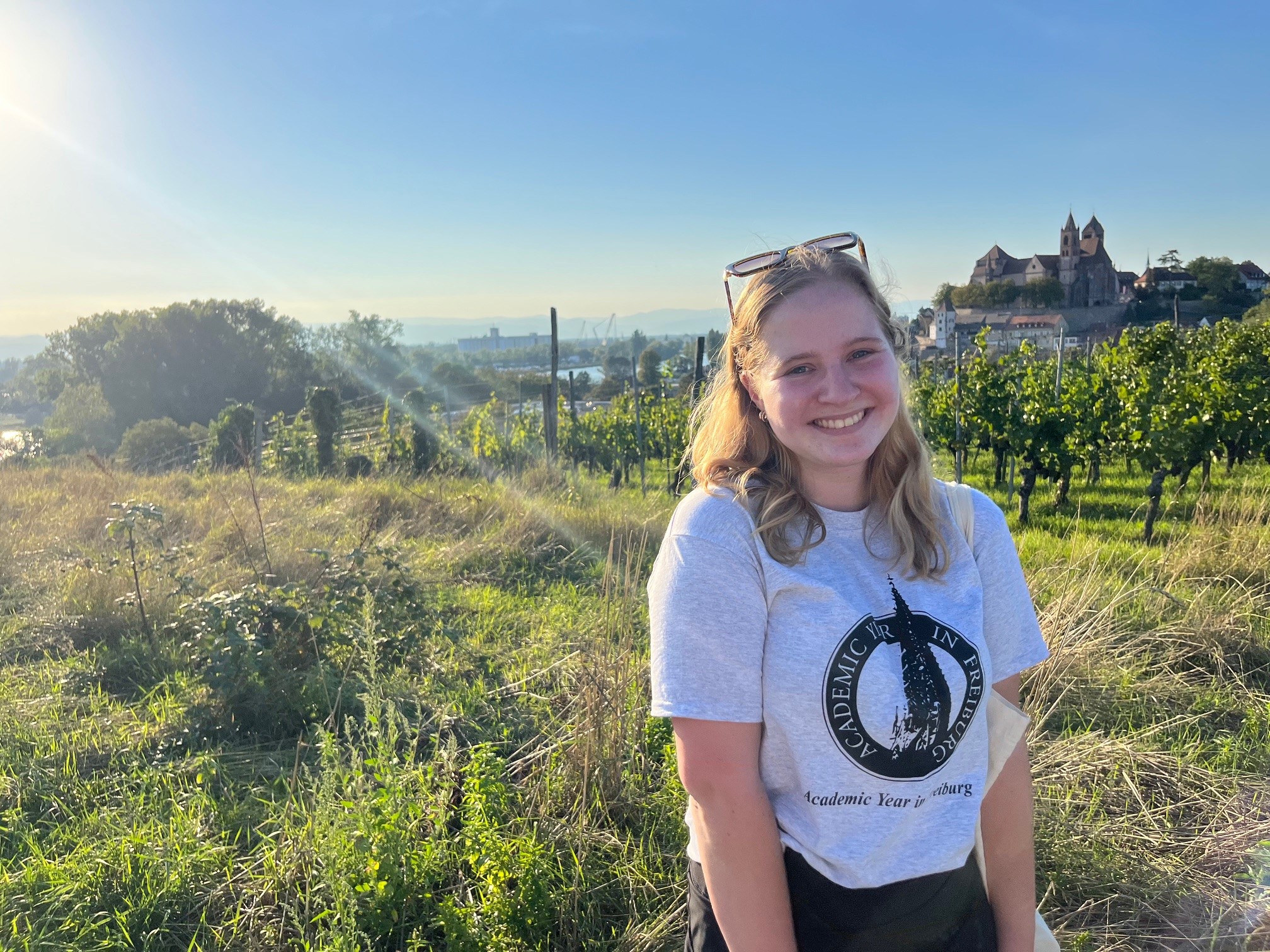
How were your program academics similar or different from taking classes at UW–Madison?
There were a great variety of options for taking classes abroad, which meant every student on the program could choose the courses that worked best for them. We could take classes that were only for students on the program; these were taught in German and structured similarly to US courses. We were also able to enroll in classes at the University of Freiburg- sometimes I would be the only international student in the class! Classes offered were usually in German, but there were some English options. Classes at German universities often require students to take more individual initiative than ones in the US. For example, many German courses have an exam or paper due at the end of the semester that accounts for 100% of a student’s grade. Students are responsible for keeping up with the reading throughout the semester. At first, I found it challenging that there were no midterms or assignments as benchmarks along the way. However, all my German professors were very supportive and happy to have office hours. I also enjoyed how many of my university classes were discussion-based.
Being in Freiburg for a whole year allows you the time to build lifelong friendships, improve your German (you will even live with German students), and feel like a local.
What is the moment you are most proud of?
I am proud of myself for walking into the office on the first day of my internship! My internship was probably the most daunting part of studying abroad, as it was a professional setting where I was alone and everyone spoke German. However, I quickly got to know the other interns and coworkers, who were very friendly and curious about my life in the US. My internship was one of the most rewarding experiences abroad, both academically and personally, and forced me a bit out of my comfort zone. I am very glad I pushed myself to do it!
Describe your internship, research, or fieldwork and how the experience helped advance your career or studies.
I interned at the Landeszentrale fuer Politische Bildung, which was a government-funded organization that promoted political education in Freiburg and the region. This aligned with my studies, as I am majoring in political science. It was eye-opening to work in a political environment and see all the work that happens behind the scenes to encourage people to vote and be politically active. I was able to interact with locals in the region; for example, I presented at a senior center and worked at an event at a high school. Overall, I was left with a greater appreciation for the intricacies of local governance.
What challenges or barriers did you face as you prepared to go abroad and/or during your time abroad? How did you work through them?
I had to set aside time to stay in touch with family and friends back in the US, because a year is a long time to be away. This was more difficult than I anticipated, because I was busy and there was a 7-hour time difference. I would write down reminders of people I hadn’t called in a while, and try to stay in contact that way. Planning calls in advance was necessary, since the time difference meant I could only call in the evenings. I also found that social media was a great way to let people know what I was up to – my friends and family were always excited when I shared photos from Germany. Additionally, I sprained my ankle while on the program. This certainly frustrated me, as it happened in the summer and was planning on going on lots of hikes around the Black Forest. However, it was an interesting cultural experience in its own right to go to the hospital in Germany (and experience the benefits of free healthcare!). My friends were very helpful and sympathetic, which helped me deal with this problem. The first day after I sprained my ankle, I could barely walk, but one of my friends carried my backpack for me while we went to our classes. Being able to spend time with my friends while I wasn’t able to do much exploring of the city helped me realize that this setback wasn’t the end of the world.