Tanzania: Audrey Wegener
Program: SFS Wildlife Management & Wildlife Research, Spring
Major: Wildlife Ecology
What is your most memorable experience from your program?
My most memorable experience from the program was the first time I saw an elephant in Lake Manyara National Park. I had seen elephants in books and documentaries before, but nothing compared to the feeling of encountering one in its natural habitat. I remember being struck by its sheer size and presence, and at the same time noticing how calm and deliberate its movements were. That moment made the reality of studying wildlife in Tanzania sink in. It was no longer just abstract concepts, but real animals in a living landscape. It reminded me why I chose this program and deepened my motivation to pursue conservation work.
Describe your internship, research, or fieldwork and how the experience helped advance your career or studies.
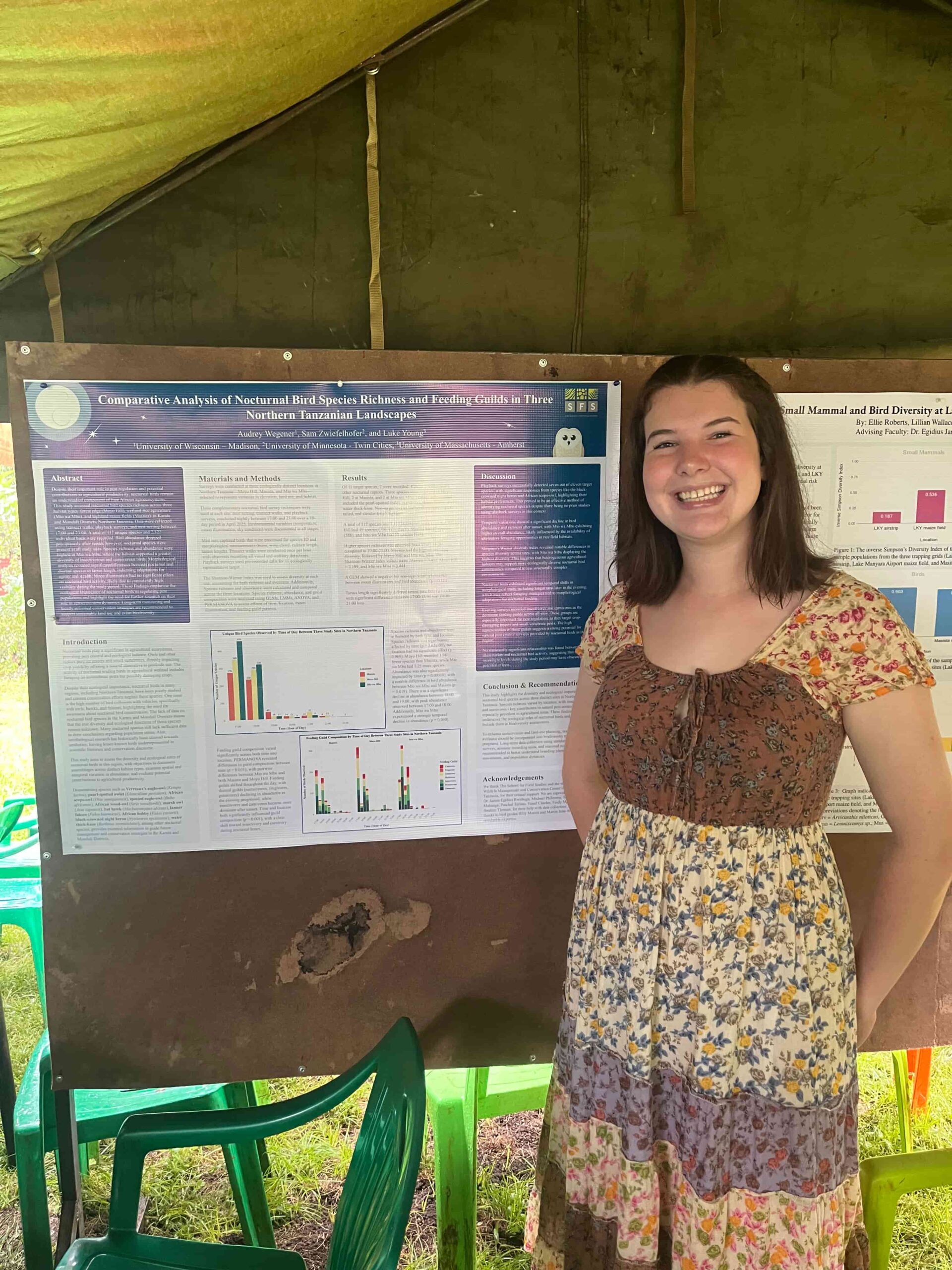
For my directed research project, I studied nocturnal birds in East African agroecosystems to better understand their species richness, abundance, and ecological role in pest regulation. My group collected data across three habitat types using transect walks, playback surveys, and mist netting between 17:00 and 23:00. From this work, I gained experience in field techniques such as bird identification, capture and handling, and morphological measurements. I also learned how to analyze large datasets and interpret ecological patterns, such as how species richness varies by habitat type and how nocturnal birds differ morphologically from diurnal species. This project advanced my career goals by allowing me to design and carry out original research from start to finish while also strengthening skills I will need in future wildlife ecology and conservation work, including field data collection, statistical analysis, and scientific communication.
This experience reinforced my passion for conservation and confirmed that I want to continue working in this field. I hope to return to Africa to contribute further to wildlife protection and sustainable land management, building on the knowledge and perspective I gained during the program.
How will your experience benefit you in the future? How might it affect your future career or studies?
My experience in Tanzania has directly shaped my career path and future studies. I developed skills in field research, community engagement, and ecological assessment. These skills prepared me to work in conservation in a meaningful way. Since returning, I have started a position with a nonprofit that focuses on conserving endangered species and supporting anti-poaching efforts in Africa. This experience reinforced my passion for conservation and confirmed that I want to continue working in this field. I hope to return to Africa to contribute further to wildlife protection and sustainable land management, building on the knowledge and perspective I gained during the program.
What is your advice for someone considering your program?
My advice for someone considering this program is to take full advantage of every free day by going out and experiencing as much as possible. There is so much to learn and explore outside of the classroom, and those experiences will become some of your best memories. I would also recommend spending minimal time in your banda and instead being present with your peers, the local community, and the surrounding environment. Finally, when it comes to the directed research project, choose a topic you are truly passionate about. The project is a major part of the program, and having a genuine interest in your research makes the process both more enjoyable and more rewarding.