South Korea: Grace Giovingo (Learning on excursions)
Program: Program: Ewha University, Fall
As part of my Korean Heritage course this semester, our professor assigned us a field trip to a local cultural site where we had to gather observations and write a formal analysis paper on our findings. When I first heard about this assignment, I was nervous because I did not really know anyone in the class and would have preferred not to go somewhere by myself. Living in a foreign country for four months means getting used to stepping out of your comfort zone, but navigating an unfamiliar heritage spot all by myself to conduct field research felt a bit too overwhelming. I decided to take a chance and ask two friends from class if they wanted to head over to Gwangjang Market together. Word spread fast, and before I knew it, our small research trip turned into ten people—classmates, friends, and even visitors traveling from Japan—all waiting together at the bus stop. Seeing our group grow warmed my heart and set the tone for an unforgettable day, proving that you can always build a little family of your own even far away from home.
I chose Gwangjang Market for my class analysis because it represents a major chapter in modern Korean urban history. Established back in 1905 as the nation’s first permanent traditional market, it was originally founded by Korean merchants to protect local commerce during the Japanese colonial era. In our course discussions, we learned how traditional markets served as essential hubs for preserving native trade, culture, and community identity. Visiting the market gave me the opportunity to see how those historical functions operate in a real-world setting today.
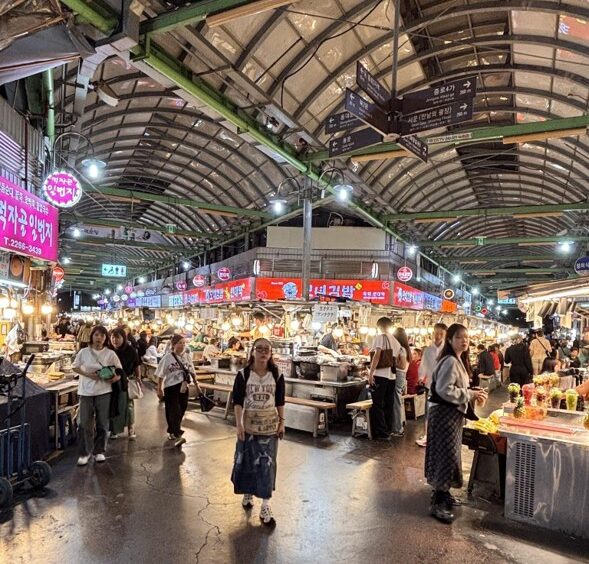
The crowded bus ride that got us to Gwangjang Market almost seemed to foreshadow what we were about to experience. When we first arrived, we thought we were in the wrong place. The giant sign over the entrance blatantly told us that we were not, yet we did not smell the delicious aroma that comes from Korean street food or hear any bustling crowds we expected. We kept walking anyway. The alley was dark and damp. Then little by little, we started to see some light and small shops that sold fried fruits.
As soon as we rounded the corner, it hit us like a brick.
The smell of fried dough, fresh fish, spices, and all the undertones that create the fragrance of Gwangjang Market. The noisy crowd that we had been missing was suddenly everywhere. Food vendors called out to us, waving menus in front of us and trying to convince us to sit at their booths. Everywhere I looked, there was something new to see. Steam rose from pots, food sizzled on grills, and people squeezed between the narrow rows of tables. My senses felt almost overwhelmed, but in the best possible way.
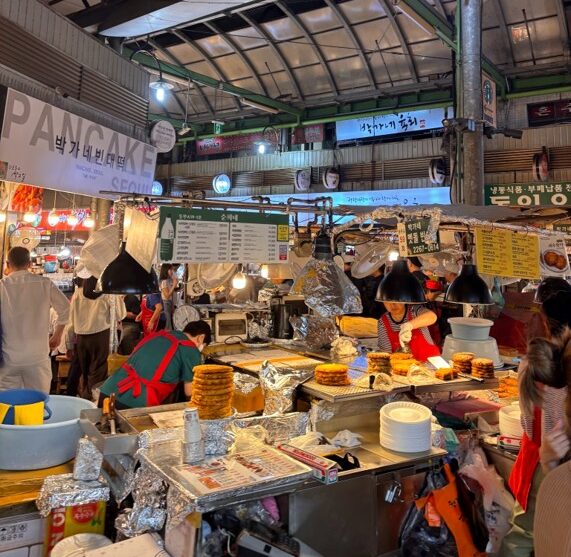
Connecting what I saw at the market back to my paper’s topic on Korean culinary heritage became effortless once we sat down to eat. Food is one of the most tangible expressions of culture, and traditional markets act as communal gathering spaces. Half of our group landed at a booth serving everything from tteokbokki to raw octopus. I tried tiny gimbap rolls and kimchi mandu. Later, we met up with the rest of the group to try Korean corn dogs. Sharing bites and comparing notes with people from different countries over simple street food brought our class concepts to life.
Gwangjang Market felt alive and fast-paced. It was surreal to be surrounded by so many people while hearing different languages spoken together throughout the crowded market. Yet somehow, in the middle of all that unfamiliarity, I felt comfortable. I was surrounded by people I cared about, sharing food and laughing together.
Completing this field trip for my Korean Heritage course taught me far more than what I eventually wrote in my academic paper. It showed me that heritage isn’t just something preserved behind glass in a museum; it lives in everyday spaces, traditional foods, and human interactions. I came to South Korea knowing I would be far from home, but that day reminded me that home is not always a physical place. Sometimes, home can be the people standing beside you, sharing a meal and making an unfamiliar country feel a little less foreign.

Grace Giovingo
Program Name: Ewha University
Major: Global Health
Hometown: Lake Geneva, Wisconsin
I am excited to deepen not only my conversational skills but also my understanding of cultural honorifics and communication styles that are essential to building meaningful connections during my time in South Korea. I am looking forward to exploring the charismatic energy of Seoul by adventuring through its diverse neighborhoods: from hanok villages to fast-paced Sinchon. I chose Ewha University because of its global reputation as the world’s most prestigious women’s institution, its foundational Christian values, and its vibrant location in the heart of Seoul.