Ghana: Global Gateway Summer 2025 (A Day in the Life 2)
Dalia C: A New Experience
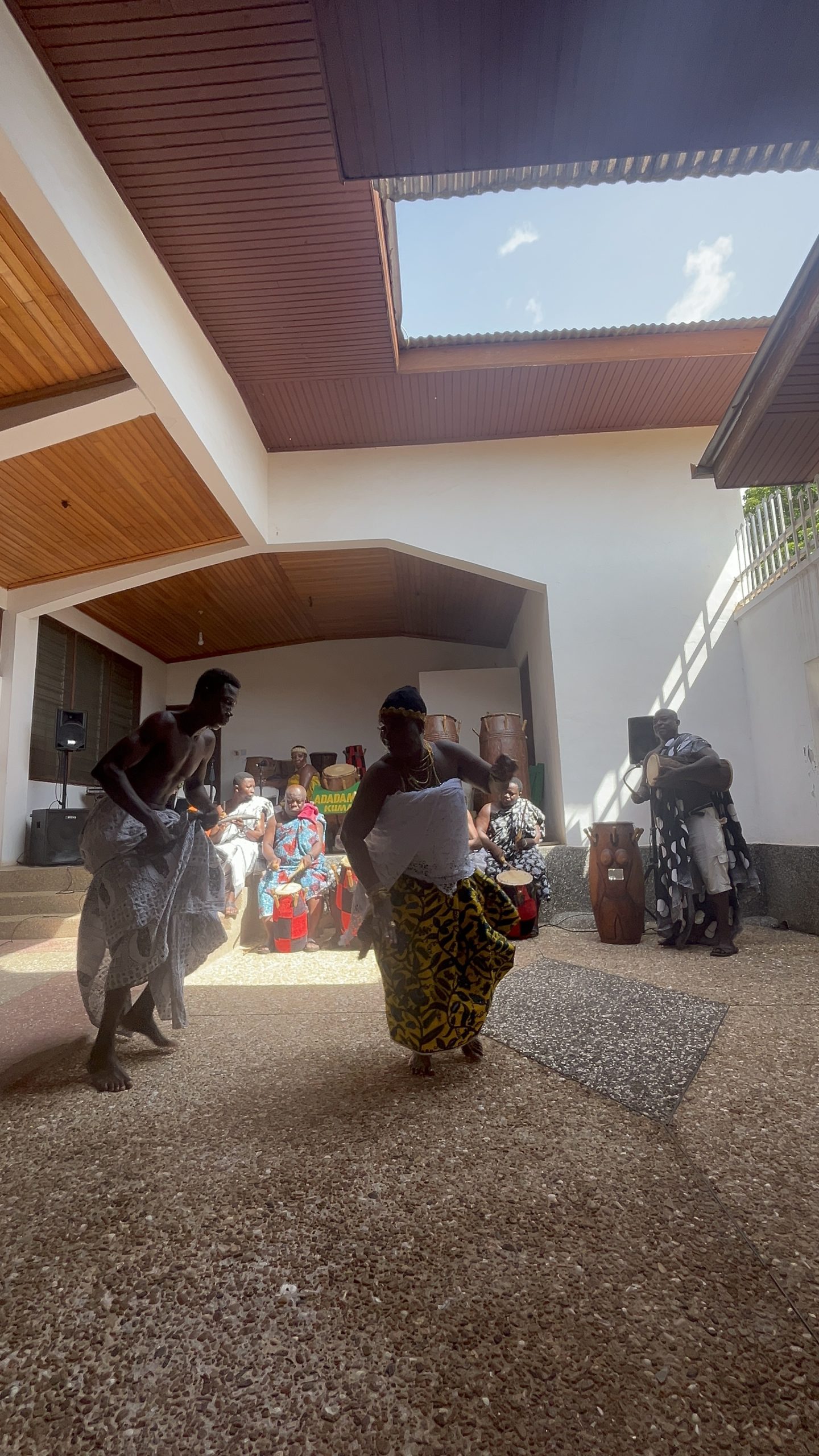
On Wednesday, May 21, our cohort had the honor of visiting Koo Nimo at his residence in Kumasi Ghana. Koo Nimo is a legendary Ghanaian artist who has dedicated his life to preserving the traditional Ghanaian music genre known as palm wine. This type of music uses African percussion, draws from calypso from Trinidad, and has influences from the Portuguese guitar. He has performed in spaces across the globe from North America to Europe and in 2007 he earned the Ghanaian title of National Living Treasure. Koo Nimo is currently 94 and was unable to perform for us. However, he joined us in a music and dance performance from his group.
We stepped off the bus and were instantly swarmed by the heat and humidity of the day. As we entered Koo Nimo’s home we were welcomed with music from his group. The men were wrapped in kente cloths in black and white patterns. We sat in lined chairs in the patio which had a large opening in the top that allowed for a fresh breezes to flow in and out. Koo Nimo spoke to us a little bit about the group and then they began to play. The first songs consisted of drums of various sizes and shapes. Some are tall and cylindrical and some are smaller with a wider top and slimmer bottom. Some drums were hit with hands and others used curved mallets to bring out the sound. There were also other instruments used like a metal piece that sounded like a cowbell and a bulbous instrument wrapped in netting and beads that you shook. To pair with the music, a woman stepped up first wearing a yellow kente dress and white cloth. She was adorned with beaded bracelets and gold jewelry. She danced solo with small steps and graceful hand movements. She motioned toward the sky and the ground. She made a series of movements that looked like she was picking fruit from a tree or gathering something. Another dance consisted of a man in black and white kente cloth who made small swaying hip movements and gestures toward the sky. It seemed like he was conversing with someone. Another woman and man danced together telling a story together. The solo woman’s dancing reminded me of bomba y plena which is a style of music and dance from Puerto Rico where women with big skirts dance in a way that is like a conversation to the beat of the drum. Bomba y plena also has a lot of African influence.
We also heard the group perform palm wine songs which were peaceful, melodic tunes accompanied by guitar, singing, and percussion as well. At the end, to our surprise, the woman called a few of us at a time to teach us how to dance. I was very nervous because although I love dancing, I don’t even do it at my family functions in front of people. However, she was very helpful, and the atmosphere was very supportive. She taught us how to step on the beat and the ways to move our hands and arms in the gesture she was making. Once everyone had a turn to learn, we were all able to dance in a circle with each of us showing off our new moves one by one in the middle. We even convinced Professor Mary Hark to join us for a bit even though dancing is not her cup of tea.
Our cohort had a great time at Koo Nimo’s home, and we are truly so grateful that Professor Mary Hark has organized such a unique experience during our time in Ghana. It was such a fun bonding moment for all of us to be in that supportive environment where we might have been nervous to try something entirely different and new in front of others. Our limbs were so exhausted by the end of our visit but not even our dripping sweat could wipe the smile off our faces.
Lia G: Learning on Excursions
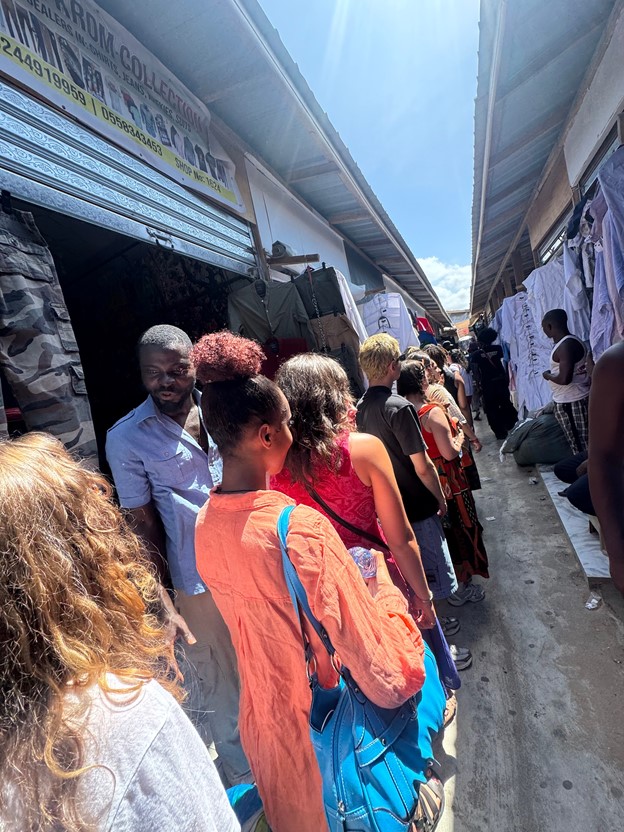
Today we went to the revival studio at Kantamanto market. The revival group is working to rescue donated fast fashion clothes that make their way into Ghana from clothing bales sold from the US. They upcycle clothes from the community, for the community, and are committed to helping the local market and local textile industry thrive. They are also using denim for upcycled pineapple farmer uniforms to prevent bruises and waste of cloth in the fields. They make sure that they are recycled from the market and screen print them to sell to raise funds for the local market to aid in financial recovery from the fires. They hope that they will be able to phase out fast fashion and waste donations to Ghana from the global north and strengthen the local market, releasing them from the self-fulfilling prophecy of a waste cycle. This is relevant to our course because it is an example of innovation through cloth that is deeply tied to the market culture here in Ghana. It is a desire for change within a long-standing system and a beautiful application of sustainability and positive action within the textile and secondhand market here in Ghana. Many of the workers involved in revival were hired from within the market, most are also young. Their location is also strategic in the way they do not want to separate themselves from the community and want to remain entangled within the system they grew up in as they improve it. I think it was interesting that most of their current market is outside Ghana, and I think that speaks volumes about the compassion of their customer base. As a sustainability focused designer, I am able to draw inspiration from their work and I hope to find a cause that motivates me to create true change from my community outwards.
Ian S: Our Global Classroom
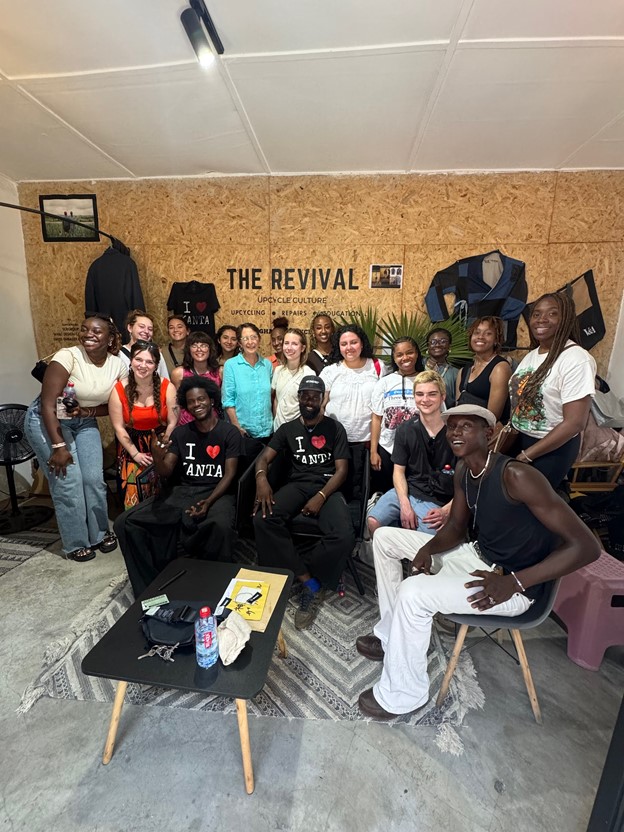
This study abroad experience has strayed far from the traditional classroom discussions and lectures I am used to. Only a small percent of the class has taken place in an actual classroom. Most of our class experience and discussion happens in public spaces, artist’s workshops, or on the road. Our lectures come from various designers, artists, and other experts we visit each day. We have had discussions with local cloth vendors, fashion designers, gallery artists, Kente cloth weavers, bead makers, and professors at local institutions. These daily excursions have made it so our lecture halls are the markets, galleries, and workspaces these people inhabit. As we are often on the road for long periods of time, the bus has also become our classroom. The bus has become home to our discussions and reflections of the day’s activities.
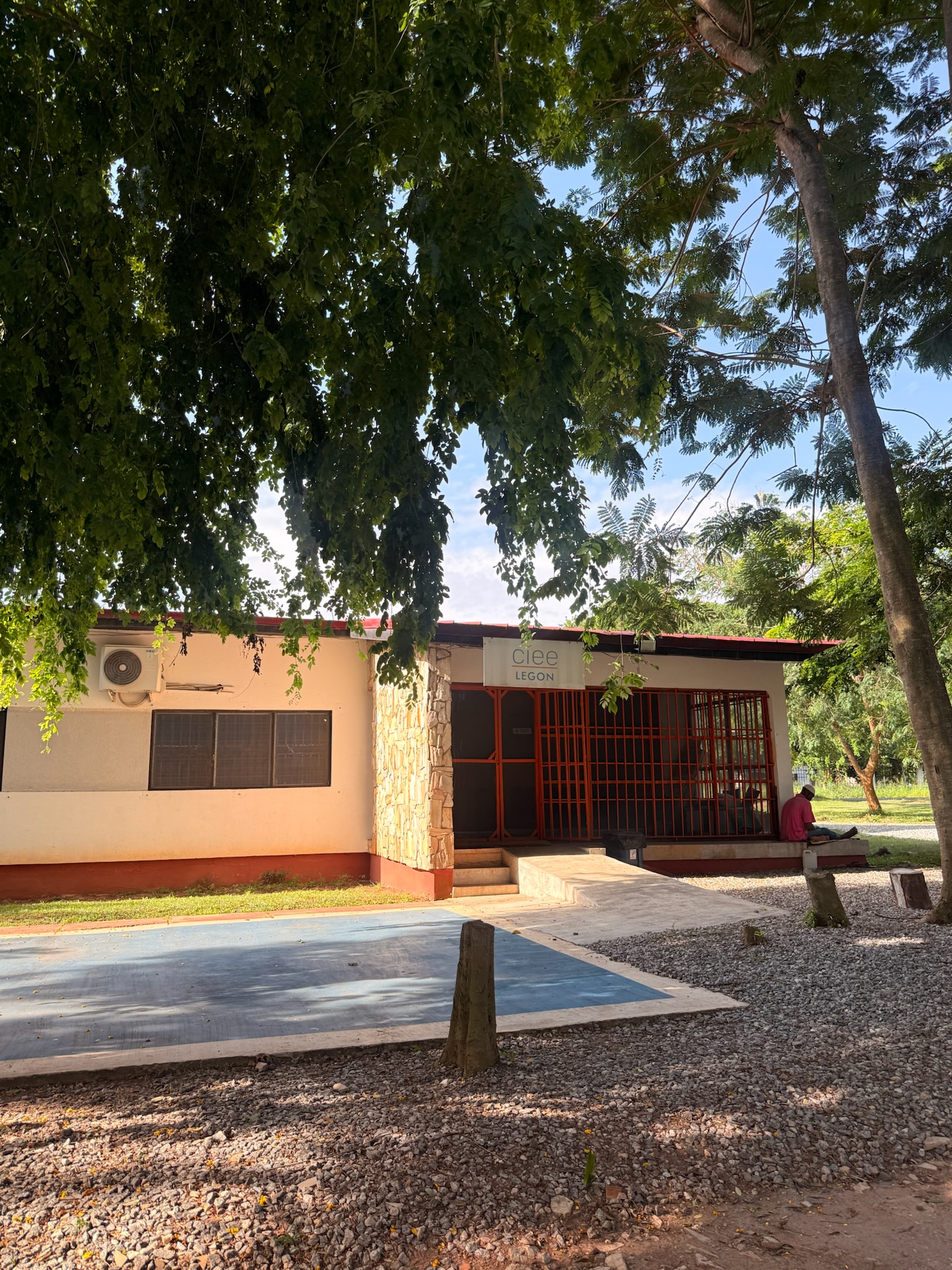
Of the traditional classrooms we have used, the ones we have been in the most would be at Kwame Nkrumah University of Science and Technology in Kumasi and the CIEE center in Legon. The classroom we used at KNUST was a large studio space used mainly by the art students, and the CIEE center is a small building on the University of Ghana campus. We used the space at KNUST to work on dying and book binding projects with local art students and faculty. The most obvious difference I noticed between the buildings here in Ghana and the buildings at UW is the prominence of open air designs. The buildings often have areas that are not fully enclosed, and the warm climate allows for these spaces.
Briunna S: “I’ve never thought about that before” Moment
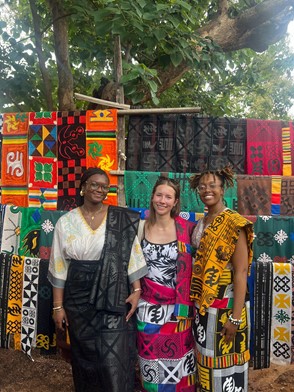
While being in Ghana for the past two weeks, I have increasingly begun to notice the attention and care that gets put towards attire and its meaning. With our program focusing on textiles and fabric, we have spent a lot of our time breaking down how they are made. Here in Ghana, there is a very long, meaningful process to making traditional attire and clothes. Each step represents something, whether it be the color that was chosen or the Adinkra symbols placed on it. In addition, the process does not end with the production line. Just as the different colors mean different things, there are different occasions to wear different symbols and colors. Such as wearing black, red, and white for different days of a funeral.
As an American coming to learn about the importance of articles of clothing, and what they convey within Ghanaian society, it makes me wonder if there are similarities in the Western American culture. In the United States, certain shoes and apparel can convey different things about you to another person. But it is more of your overall appearance that places you into a category such as business or sporty. While in Ghana, to narrow it down to the Adinkra symbols, a certain symbol could convey hope, while another could convey power. In the case that there is more meaning behind what we wear in the States, I hope to learn more about it. By learning the meaning, it can help me put more thought into my outfits to correctly convey myself to individuals I meet.