Washington, DC: Global Gateway Summer 2025 (A Day in the Life 2)
Haia A: Our Global Classroom
We’re currently taking a political science course on political polarization with Professor Amy Gangl. Our classroom is located near the Supreme Court, which makes the walk there interesting each day. On the very first day of class in D.C., we passed a protest in front of the Supreme Court advocating for birthright citizenship. Since then, our walks have varied with the weather, sometimes rainy, sunny, or warm. Once we arrive at the UW–Madison office, we usually take five minutes to grab some water and settle in before class begins.
Class typically starts with a discussion of the assigned reading, followed by videos that relate to the day’s topic. For example, one class was focused on the concept of reality and how our perceptions are shaped by our own experiences. Our reading that day was Chapter 3 of How Minds Change, titled “Socks and Crocs.” The chapter explored how unfamiliar experiences can feel uncomfortable and challenge our understanding of reality.

To bring this to life, we watched a video about QAnon supporters and how their perception of reality differs from others. We also viewed a video of an older man who initially expressed homophobic views, but after speaking with a gay woman, his attitude began to change. He mentioned he had never knowingly met a gay person before, which made the concept feel foreign to him. That conversation helped shift his perspective, showing how personal interaction can influence one’s worldview.
Typically, after watching videos like this, we break into small groups to discuss what we’ve seen and read, using guiding questions from Professor Gangl. In some classes, we’re given a worksheet to help us reflect on what we’ve just seen, which then leads into a full class discussion. While each class looks a little different, the conversations we have are always meaningful, thought-provoking, and engaging.
Outside of class, we’re constantly learning, whether it’s through visiting the Smithsonian museums or observing court cases. One thing I’ve noticed, especially in relation to our course on political polarization, is how these divides play out in everyday life.
Kahlila B: Learning on Excursions
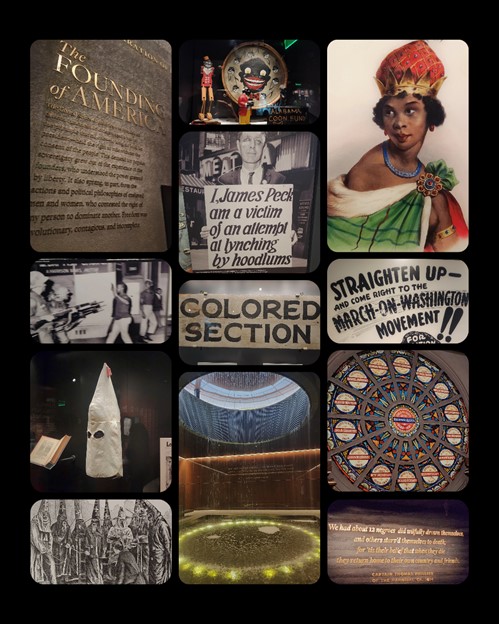
One excursion that was extremely meaningful to me and impacted my understanding of the class was our exploration of the National Museum of African American History and Culture. Something that specifically stood out to me was seeing how polarization to some extent is baked into the fabric of our country. Slavery and the Civil War reflect a breaking point at which our nation was so polarized, but even after the Civil War, polarization continued to a lesser extent and has had peaks and valleys since. Currently, political differences are so strong that the nation is climbing towards a Civil War-like peak. The National Museum of African American History and Culture has allowed me to view the reality of what extremism breeds and what extreme polarization pushes general people to accept.
Another thing that surprised me was the large number of visitors sporting politically affiliated clothing in a space that is often considered bipartisan. This speaks to how, in a highly polarized society, individuals tend to internalize their political beliefs and hold that their beliefs represent them as a person. This internalization leads to a cycle in which individuals feel that differences in political opinions or affiliations are an attack on their personhood, which pushes us further and further apart. I feel that both the museum as an institution as well as my experience at the museum helped me to understand the current state of polarization both historically and currently on a deep level.