South Korea: Global Gateway Summer 2026 (A Day in the Life 1)
Program: UW Global Gateway in South Korea, Summer
Lailanny D A: Places: Routine & Favorite
Every day at 6:00 A.M., the ringing sound of my alarm radiates through our hotel room. Upon landing in South Korea, various things were different. For starters, the jet lag that followed our 24-hour trip to Seoul, as well as the culture, food, and language. I can still recall the night of our arrival as my current roommate and I settled into our assigned room; the instant we entered, our exhaustion took over. We crashed into our designated beds and rested as preparation for the next day.
As you can tell, part of my daily routine while in Seoul, South Korea, is to go on various fun, outdoorsy, and educational excursions. Every morning, I wake up around 6 A.M., when I begin getting ready for the day. Around 8 A.M., a group of my friends and I from the program meet up near the elevator and then head down to breakfast. In our hotel, the breakfast is a fusion of American and Korean cuisine, ranging from kimchi and fried rice to eggs and bacon. After breakfast, we grab our bags and head towards our lecture or daily morning excursion.

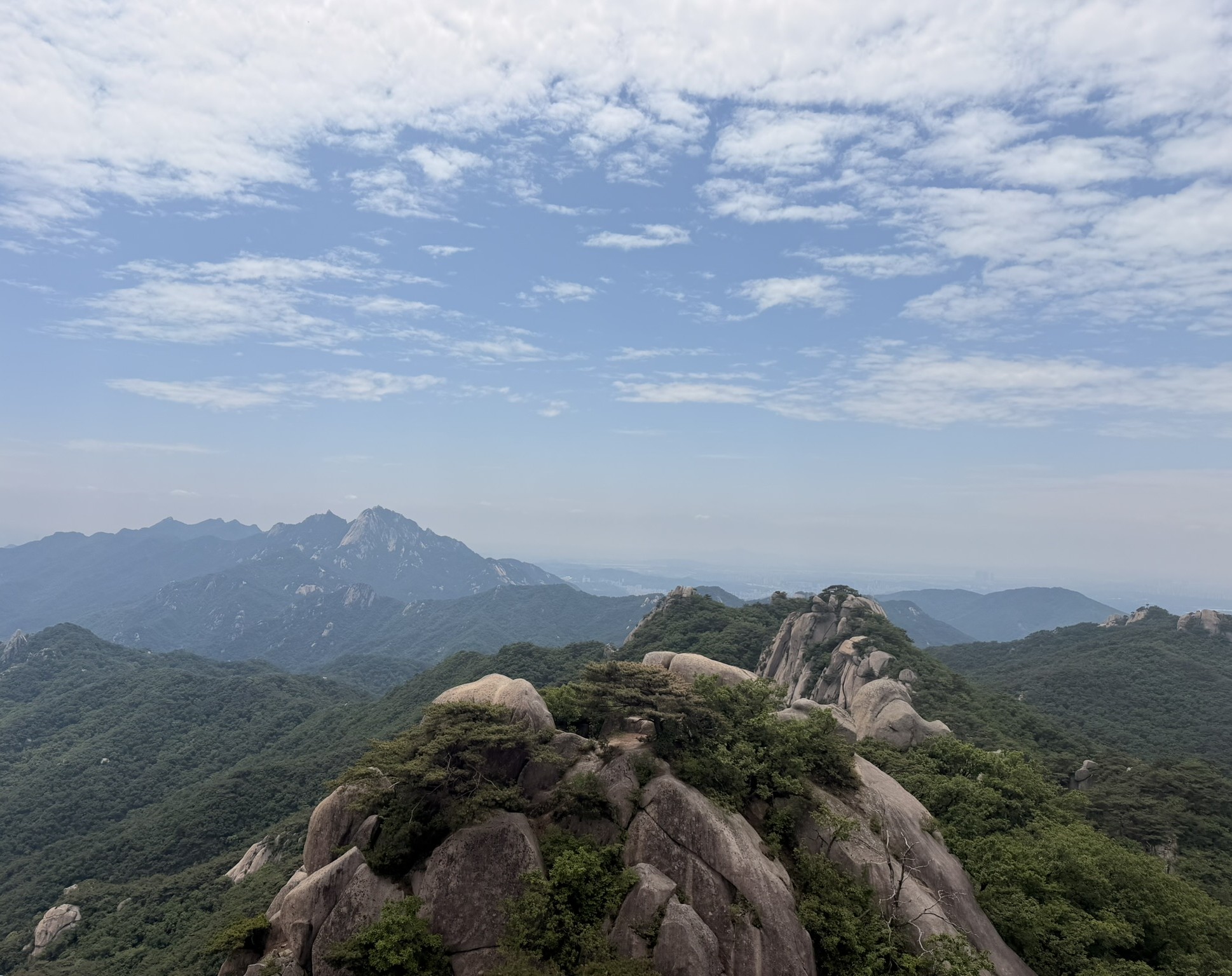
Unlike what we all initially expected, our experience in South Korea was quite vigorous. The morning after our arrival, we ventured out into the city via the Korean subway and bus system. In a group of about eight individuals, we ventured into the Seoul National Cemetery and Deoksugung Palace, where we gained deeper insight into Korean history, especially regarding Japanese colonization. The next day, though humid and hot, we walked up the Seoul City Wall, where we got to experience beautiful views and observe multiple statues of historical Korean figures like Kim Gu. Then on day 3, we did a six-hour hike up Dobongsan Mountain.
Thus far, however, I’d have to say my favorite place in Seoul has been Gyeongbokgung Palace, where my friends and I had the opportunity to dress up in hanbok and walk around this beautifully historic palace. I will say my most memorable and heartwarming memory of this experience was when this elderly couple asked our group to take pictures with them. Overall, being able to directly interact with the community we’re learning about in this program has been an extremely rewarding experience and something I look forward to sharing more about in the future.
Shakur H: Food in Seoul
During my time in this program, I noticed how food in the city reflects both Korean traditions and international influences. Walking through different neighborhoods such as myeondong I would see a variety of street food that I would not see in the USA. Besides the street food the restaurants also stood out such as the Korean barbecue restaurants, fast food restaurants, and pho restaurants. It showed me how global Seoul is while still keeping a strong Korean identity through the way people eat and share meals together.
One of my favorite experiences so far was definitely trying Korean barbecue. Cooking the meat with my friends at the table made it feel more interactive and social compared to the ones back home. The system of only paying for the main dish and having side dishes such as the extra meat be free was something that shocked me. I also tried fried dumplings, which quickly became one of my favorite foods because they were crispy on the outside and warm inside.
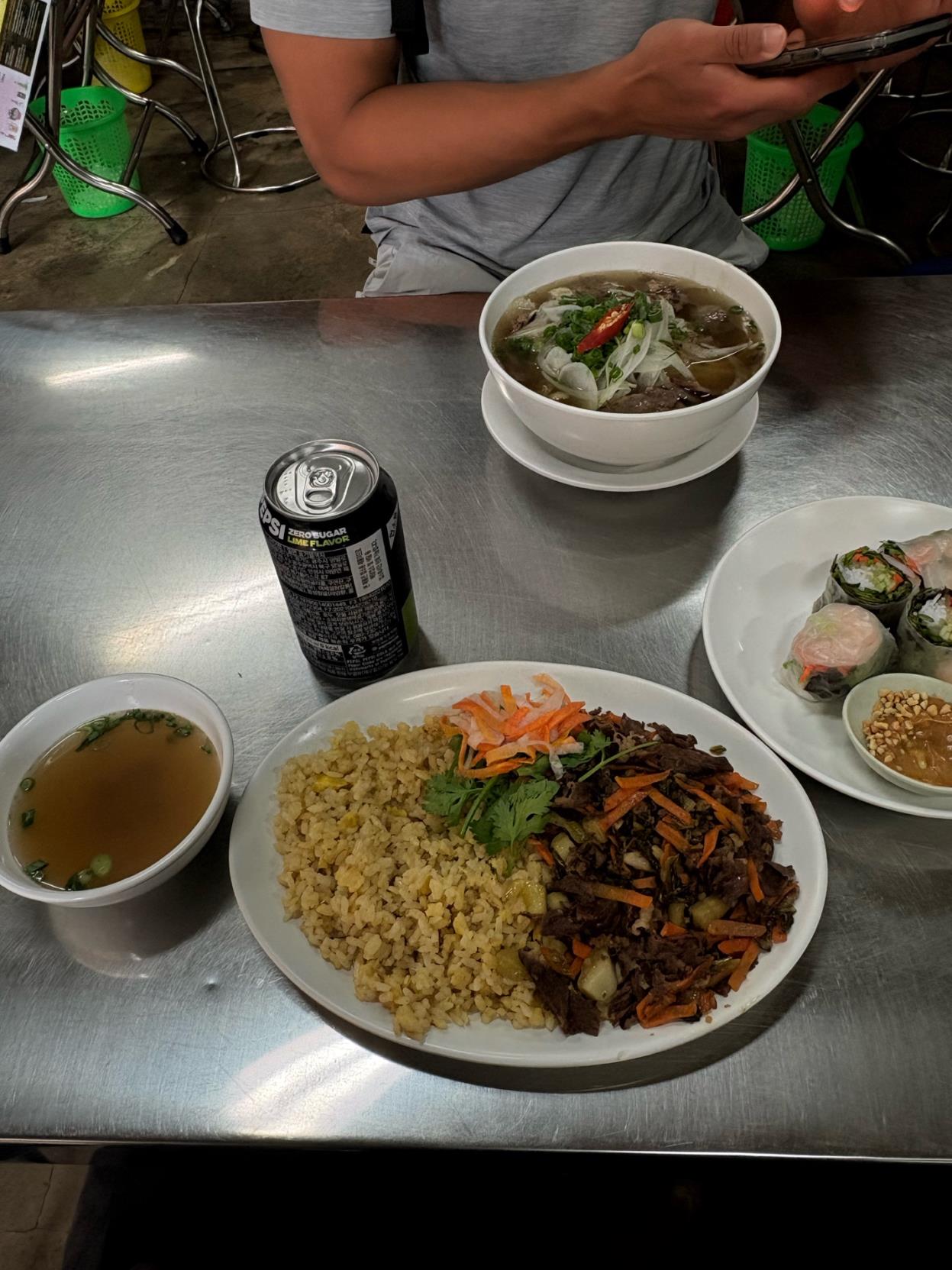
Not every food I tried became a favorite though. I tried kimbap which I don’t really know what’s inside, it was rice and vegetables wrapped in seaweed. I think the texture and seaweed flavor threw me off a little. Even though I did not love it, I still appreciated getting the chance to try something that is such a common everyday food in Korea. Maybe I just got the wrong fillings inside and should try one with a different sauce, but it was definitely an experience overall.
Another interesting part of the experience was trying American food in Korea, including Shake Shack and Burger King. I immediately noticed the differences, such as the burgers in burger king were massive and the milkshakes at shake shack tasted a bit off. This made me realize even with the same restaurant chains, due to food culture it may taste slightly different or very different depending on said restaurant and country.
Autumn L: Public Transportation in Seoul
On our first day, to my and my peers’ surprise, we were given the task to navigate through Seoul on our own. I felt so independent figuring out the bus system, especially with my lack of understanding of Korean and Hangul and use of Papago (a translator app). We traveled out over thirty minutes out and went over the Han River to Yeouido and again to Gangnam. The views were gorgeous, and the time traveling was peaceful.
Public transportation is the most common mode of transportation, since it is still considered a luxury to own a car here. We’ve taken buses and the subway, both of which have been very reliable and easy to use. Thanks to the centralized form of payment, the T-Money card, we simply swipe our cards at stops and stations to get on and are charged for the distance we travel.

Compared to Madison, it feels very different. Not only for the system itself, but also for the cultural norms around public transportation. The expectation is that people are quiet and taking calls is a big no-no. I think this kind of different is nice. I was able to sit or stand and stare out the window and think, without the kind of hustle and bustle you can hear. I reflected as I watched the many high rises and small mom and pop shops, intermingled in neighborhoods together.
Ella L: Daily Life in Seoul
My typical day in South Korea starts with getting ready in the morning to go to lecture at nine. Dr. Fields, our program leader, gives us a lecture about Korean and US relationships throughout history for two hours. Depending on the day, we either have time to explore on our own or a group excursion to go on.

We leave to eat lunch and regroup typically at one in the afternoon to go on an excursion, such as meeting with LiNK (Liberty in North Korea), the East Asia Foundation, Dobongsan Mountain or the Korean War Memorial. If we are free, my friends and I go to lunch and talk about what we want to do that day. For instance, we went to Gyeongbokgung Palace and wore Hanboks (Tradition Korean Dress) and Seoul Forest to see a Pokémon pop up event.
A lot of our time is spent like most locals. We take public transportation like the bus or train, or we walk wherever we go. We get local food when we are out and about, such as banchan, street food, tteokbokki, and Korean BBQ. We make sure we are respectful to manners in Korea like being silent on public transportation or walking at a brisk pace. Our life in South Korea has been a lot of fun and educational with being able to take information we learned and apply it to places we have been.
Jigme S: Food in Seoul
Ever since arriving in South Korea for this program, it has been amazing and a complete blessing to try foods I am not familiar with. Even visiting familiar franchises like Shake Shack and Burger King is an entirely different experience. Each country puts a twist on the main dishes, for example, the burgers here are larger, and the sandwiches have a tangy taste and aroma that ties back to Korean taste preferences and food heritage in essence.
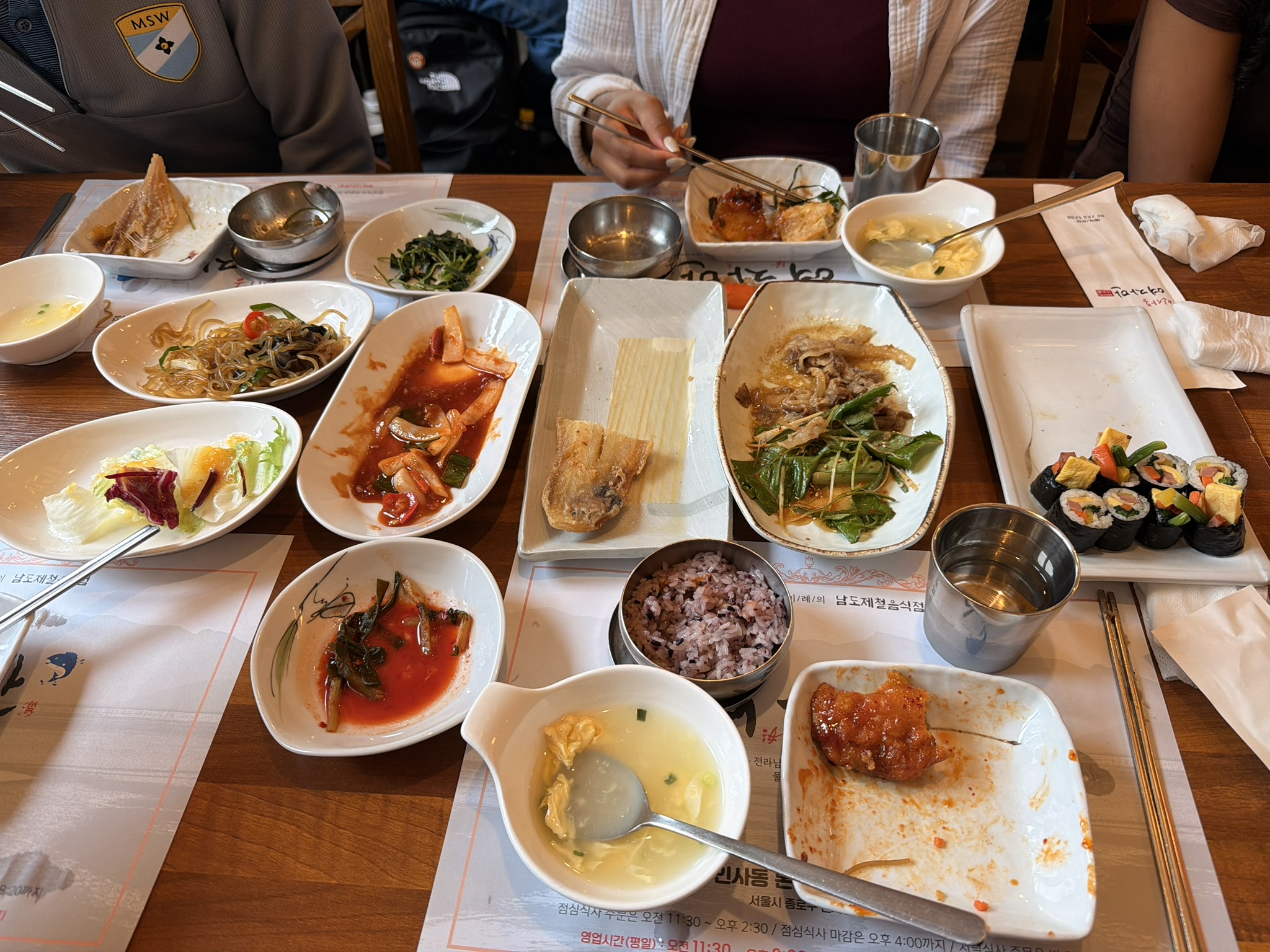
On the day of our first museum event, we went to a joint cohort lunch organized by CIEE at a traditional Korean restaurant. We didn’t even look at the menu. The staff just started serving us with the utmost respect. They brought out a bunch of side dishes, like some kind of egg soup, kimbap (meat or fish, fruit, and rice wrapped in seaweed), and a pork dish called Bulgogi, which is widely known around the world and a staple here.

Communal dining is the norm here. Most of us in the cohort had to adjust to sharing all the side dishes one by one, eating them with our bowls of rice. This communal eating style almost makes you feel like one big family, which is an aspect I don’t really see in the US. Also, the respect we learned about in our Korean history classes on Confucianism plays a huge role in dining. You never pour a drink for yourself. If someone is older than you, you must pour for them first with two hands as a sign of respect and class ranking.
Additionally, a major food influence I have noticed is the street food vendors at the markets in Seoul. The food is drastically unfamiliar from what we see in the States. I recently tried Beondegi, a traditional snack of boiled silkworm pupae, and Bungeo-ppang, a fish-shaped pastry stuffed with sweetened red bean paste. Having never been to Korea before, trying these was almost otherworldly. The Bungeo-ppang dessert had a creamy, sweet bean taste, while the silkworm snack was crunchy, slightly salty, and kind of shrimpy and fishy. It was not necessarily my favored dishes, but trying such unique delicacies of Korean culture was definitely my most memorable experience so far.